

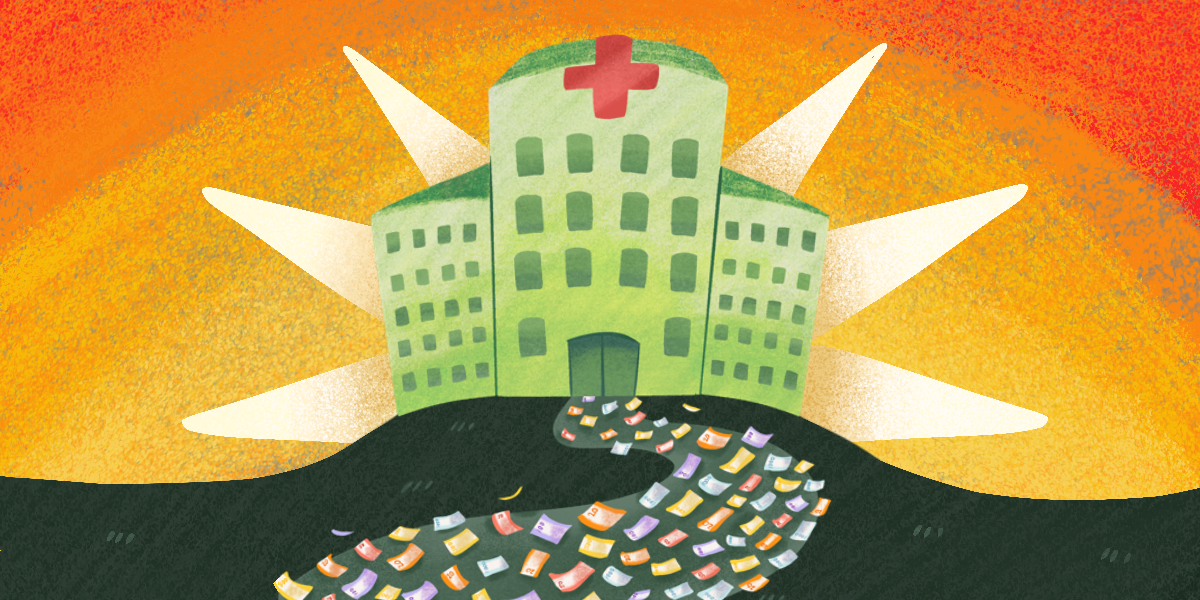
Utang na buhay: The financial burden of Philippine hospital bills
In the country, healthcare is so inaccessible that everyday Filipinos are forced to live with the uncertainty of being one hospitalization away from bankruptcy.
Keeping one’s sense of humor in the darkest of situations is often a tell-tale sign of being a Filipino. So much so that, if you were to ask a Filipino undergoing chemotherapy whether the procedure hurts, it wouldn’t be surprising for them to quip, “Mas masakit sa bulsa.” (“I’m more concerned about my finances.”)
However, this is hardly an exaggeration for comedic effect. The pains of receiving medical treatment in the Philippines go far beyond the expected physical ones.
In the top 10 most populated areas around the Philippines, one would have to travel over six kilometers on average to get to the nearest hospital. Elsewhere in the country, that distance more than doubles at 13.96 km. For every thousand people in your average municipality, the number of hospital beds the Philippines can offer is surprisingly only one, compared to Japan’s 13.4.
The issue of medical accessibility barely scratches the deep trench that is Philippine healthcare. It’s one thing to be able to make it to the hospital, it’s another to consider whether one can even foot the bill. Everyday Filipinos are more or less resigned to the idea of being a couple medical emergencies away from bankruptcy. With all the hurdles and costs placed on the shoulders of those seeking treatment, the price tag that comes with maintaining one’s health can be ultimately out of reach for the most vulnerable people.
The cost of saving a life
Even for the same disease, the cost of receiving medical care in the Philippines can differ wildly. This depends on a myriad of factors, such as whether the clinic administering the service is public or private, the type and extent of treatment, and how much the healthcare workers charge in professional fees.
While the country’s laws currently impose some restrictions on the fees charged to patients in government hospitals and charity clinics, their private counterparts have more autonomy to set their own standards. The “Standard Medical Professional Fees Act” filed in December 2025 sought to regulate physicians’ professional fees to some extent. As that bill has yet to be approved, however, medical professional fees for private institutions are still largely dependent on the medical professionals themselves and can weigh heavily on the patient.
Other fees that might show up on a hospital bill include room fees for in-patients, laboratory testing fees, medical instrumentation fees, and nursing fees. These don’t yet account for consumables such as medicines, oxygen, and other supplies that may even be marked up in price by the hospitals. Add all these up and it’s no wonder a brief stint at the hospital can make more than a significant dent in one’s finances.
With this in mind, PhilHealth was created a little over 30 years ago in the hopes of offsetting these costs and implementing universal health coverage in the country. Unfortunately, while PhilHealth does ease some of the load, its coverage is not so high that Filipinos don’t feel financially burdened when undergoing regular medical treatments.
A 2018 study published in Acta Medica Philippina showed that the average out-of-pocket chemotherapy expenses in the Philippines for the first year after diagnosis is approximately PHP 181,789. For people who rely on hemodialysis treatments, on the other hand, PhilHealth can cover up to PHP 6,350 per session. This can be enough for the basic treatment, but cannot be used to cover supplementary medicines and professional fees.
The coverage PhilHealth does provide for professional fees is not aligned with actual standards in clinical practice. That coverage is well below half of the perceived acceptable professional fees for the five most common medical procedures, according to a 2024 study in the Philippine Journal of Surgical Specialties. For example, PhilHealth lists the professional fee coverage of an appendectomy to be PHP 6,720 when the perceived acceptable fee among physicians is somewhere between PHP 20,000 to PHP 40,000.
Ignoring the issues
Boston Consulting Group (BCG) Manila reported that vulnerable populations, such as children and the elderly, often do not have HMO coverage. As such, those that are family breadwinners cover their dependents through their health insurances. In the same report, adults even when completely insured usually delay their personal care but prioritize that of their dependents, with a response rate to unusual symptoms falling from 69% for seniors to 54% for adults.
Additionally, according to the congressional Policy and Budget Research Department, the national average for annual family income in 2023 was around PHP 353,200. In that same year, the national average for annual basic family expenditures (such as food, housing, utilities, and transportation) was around PHP 258,100. This leaves the average Filipino family with approximately PHP 95,100 a year for savings and miscellaneous expenses, which can unfortunately include medical emergencies.
According to PhilHealth, the average cost for in-patient hospitalization in 2021 was a little under PHP 72,000. After accounting for the estimated basic yearly expenses, just one visit to the hospital could wipe out the average family’s entire budget if paid out of pocket. Indeed, the Philippine Statistics Authority reported that out-of-pocket health spending in 2024 skyrocketed to more than PHP 615 billion, which is equivalent to nearly half of the total healthcare expenditure.
Under these circumstances, many Filipinos are forced to opt for subpar alternatives to their medical needs, or simply delay care for their medical concerns completely because they cannot afford it. The sobering reality is that at least 7 in every 10 cancer patients in the Philippines drop out of their treatment regimens due to lack of funds, which leads to premature and otherwise preventable deaths.
Where we should be headed
Under the United Nations’ Sustainable Development Goals, Universal Healthcare Coverage (UHC) envisions for all people to “receive the quality health services they need, without experiencing catastrophic health spending due to healthcare costs.”
UHC is formally evaluated through “tracer indicators” based on health services ranging from maternal and child health to infectious diseases and chronic disorders, while accounting for service capacity and access. The resulting ratings come in the form of unitless numbers from 0-100 as an index of healthcare coverage.
With a healthcare system plagued by issues of access, it is perhaps no surprise that the Philippines is also not faring well on these global metrics. The country has a UHC service coverage rating of 66, lower than most of our ASEAN counterparts. Our nearest neighbors, Indonesia and Malaysia, stand at 77, while Thailand has garnered an impressive 87. While this rating is not always an exhaustive metric, it does serve as an important proxy marker for the financial impact that healthcare bills can have on the average citizen, and even more so, on vulnerable groups.
Advancing the agenda of UHC, the World Health Organization (WHO) instituted a rigorous framework to achieve Triple Billion Targets by 2023: “one billion more people (1) benefitting from UHC, (2) protected from health emergencies, and, (3) enjoying health and well-being.” However, the world has collectively missed the target by a sizable margin of at least 800 million people, largely due to the significant setbacks during the COVID-19 pandemic. As of 2023, at least a quarter of the global population still faced financial hardships stemming from health expenses.
A follow-up agenda has since been established to help steer the world back on track by 2028, particularly amid constant upheaval such as climate change, geopolitical issues, and global migration. An “absolute goal” for WHO is for “5 billion [people to] be able to access health services without financial hardship,” potentially saving 40 million lives globally over the next three years.
Covering more ground and the case of Taiwan
Healthcare coverage, as with many societal issues, should be understood from a structural lens. Its solutions may lie in reorganizing healthcare coverage institutions to promote a more efficient and equitable system that is not plagued by bureaucratic vulnerabilities. Taiwan’s healthcare system may offer important insights.
In 2017, the country allocated 3.4% of its GDP toward health insurance. Although not particularly high relative to Organization for Economic Cooperation and Development standards—the United States, for instance, uses up around 18% of its GDP—Taiwan has among the most efficient health coverage systems in the world which also reflects in the quality of life of its people.
Its National Health Insurance program, adopted in 1995, funds insurance mostly through premiums from individuals, employers, and the government, but also derives from miscellaneous sources such as tobacco and lottery taxes. In this single-payer system, only one person in each household pays for the insurance, with premiums increasing up to three other dependents. The rest of the household would then be covered for free. This cap applies for both payroll-based and supplemental premiums, akin to direct and indirect contributions in the Philippine system.
To reach those in need, healthcare services are mainly carried through private delivery systems. The key piece that holds the system together is a centralized, public funding scheme that has swaying power over government expenditures. Through this equitable and comprehensive system, a whopping 99.9% of the population is covered for all sorts of healthcare needs. In 2012, the average Taiwanese citizen only paid for about 12% of necessary healthcare items, including medical check-ups and dental care as well as prescription drugs.
Toward better care
“Up to 64% of the Filipino population cannot pay a PHP 10,000 hospital bill without borrowing,” a 2025 BCG Manila report highlighted. With these alarming figures, out-of-pocket expenses will continue to balloon if more decisive and comprehensive action is not taken.
A perspective piece published by a global, healthcare-focused think-tank, ThinkWell, commented on the state of healthcare coverage in the Philippines. They posited that, although the creation of Philhealth has centralized insurance premiums, LGUs hold too much influence over how healthcare is financed and administered. This has led to resource inequities and funds not always being allocated to where they can make the most impact. If any meaningful change is meant to happen, ThinkWell suggested that reforms in the healthcare system should start at the local level.
Universal healthcare is, as described by the WHO, a mandatory right of every person. Therefore, failing to achieve its metrics reflect poorly on our state of nation. Utang should not be treated as a personal shortcoming, but rather a systemic issue where every major stakeholder should be considered—especially the poor and vulnerable populations. After all, a healthier Filipino citizenry is key to an economically prosperous and stable future for all.